
Commercial caulking projects often involve challenges that aren’t immediately visible. Large properties can include interior courtyards, narrow access points, and finished surfaces that limit where equipment can be used. When caulking in cold weather is added to the equation, it’s easy to understand why many projects are delayed or approached cautiously.
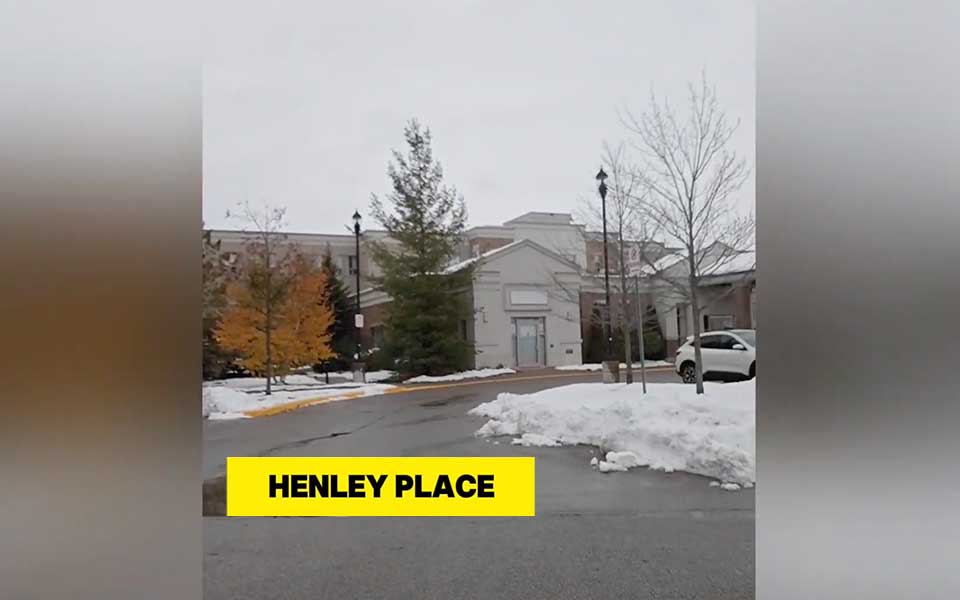
The Henley Place project shows how those challenges can be managed with proper planning. The work included extensive window perimeters, vertical joints spanning multiple storeys, and areas that could not be accessed with traditional boom lifts. Rather than compromising the work or the surrounding property, the project required a deliberate approach to both access, materials, and winter conditions.
Can commercial caulking really be done in winter?
This is one of the most common questions property managers ask. In practice, the season itself is rarely the deciding factor. What matters more is surface condition, moisture control, and using sealants designed for cold-weather application. When conditions are dry and the correct products are selected, commercial caulking can be completed effectively even during colder months.
Projects like Henley Place highlight why professional commercial caulking services are essential when access, timing, and building conditions all need to be considered together.
Video Transcript
Okay guys, we’re just getting to Henley Place. This is a long-term care residence, and we’re just finishing up the project. It took us about two and a half weeks to complete.
We had to bring in some specialty equipment because there are courtyards and tight areas where you can’t really get a boom lift in. We have our crew here, and I’m going to bring you around so you can take a look.
Alright guys, we’re here. Look how huge this place is. I’m going to show you what we’re doing. We’re replacing the caulking around all of the windows, the joints, and some vertical joints that run all the way up the building. All of it needed to be replaced.
You can see we’re using the correct colour. It matches the window frames perfectly. We’re using a silicone product that’s rated down to minus twenty-nine degrees Celsius.
A lot of people think you can’t do caulking in the winter, but the cold itself isn’t the problem. As long as conditions are dry, the product is still rated for cold-weather application, so we’re good to go.
On many commercial projects, there are areas that are difficult to reach. You can’t always bring in large, clunky machinery, especially in tight spaces.
The beauty of this specialty equipment is that it fits into very small areas. You can see this narrow walkway here. If we brought in larger machinery, there would be a real risk of damaging the asphalt or surrounding landscaping.
This equipment uses stabilizing legs that allow it to be positioned safely without disturbing the property. It gives us the reach we need while protecting the surrounding surfaces.
If you’re looking for a professional team and you have a large project like this—or even a smaller one—we handle both. Let us impress you. Give us a call.
Assessing a Large Commercial Property
Henley Place is a large long-term care residence with a substantial building envelope. Over time, sealant around windows, doors, and expansion joints had deteriorated across multiple areas.
Why choose full sealant replacement instead of spot repairs?
When failure is widespread, localized repairs often don’t hold up long-term. Full removal and replacement allows joint depth, adhesion, and flexibility to be properly restored, reducing the likelihood of repeat failures.
A detailed site assessment helped determine where removal was required, how access would be managed, and how the work could be completed without disrupting daily operations.
Why Access Planning Matters
Many commercial properties include areas that are difficult to reach safely.
Why isn’t standard access equipment always suitable on large properties?
Interior courtyards, narrow walkways, and sensitive landscaping can make large boom lifts impractical. Forcing standard machinery into these areas increases the risk of surface damage and limits safe positioning.
So how do contractors reach tight or restricted areas safely?
For this project, compact specialty equipment was used. Spider lifts are designed to fit into confined spaces while still providing the reach needed for multi-storey work. Their small footprint and stabilizing legs allow them to be positioned safely without placing unnecessary stress on surrounding surfaces.
Cold-Weather Commercial Caulking
A common misconception is that exterior caulking must stop once temperatures drop.
What actually limits caulking work in cold conditions?
Cold alone is rarely the issue. Moisture, surface preparation, and product selection play a much larger role. As long as conditions are dry and the correct materials are used, caulking work can continue through colder months.
For Henley Place, a silicone sealant rated for application down to −29°C was selected. These products are designed to remain flexible in cold conditions, allowing the sealant to move as the building expands and contracts. Colour matching was also carefully considered so the finished work blended cleanly with existing window frames.
Project Timeline and Key Takeaways
The Henley Place project was completed over approximately two and a half weeks, with the facility remaining operational throughout the process. Careful coordination and phased work helped minimize disruption to residents and staff.
What should property managers consider before scheduling winter caulking work?
Access limitations, product selection, weather conditions, and overall scope all need to be evaluated together. When these factors are addressed early, winter caulking projects can be completed safely, efficiently, and with long-term performance in mind.
Projects like Henley Place show how commercial caulking can move forward even in challenging conditions, as long as the right materials, access planning, and experience are in place. For property managers facing similar access or seasonal constraints, understanding what’s possible is often the first step toward planning work with confidence.